
Listen to your gut
November 20, 2026

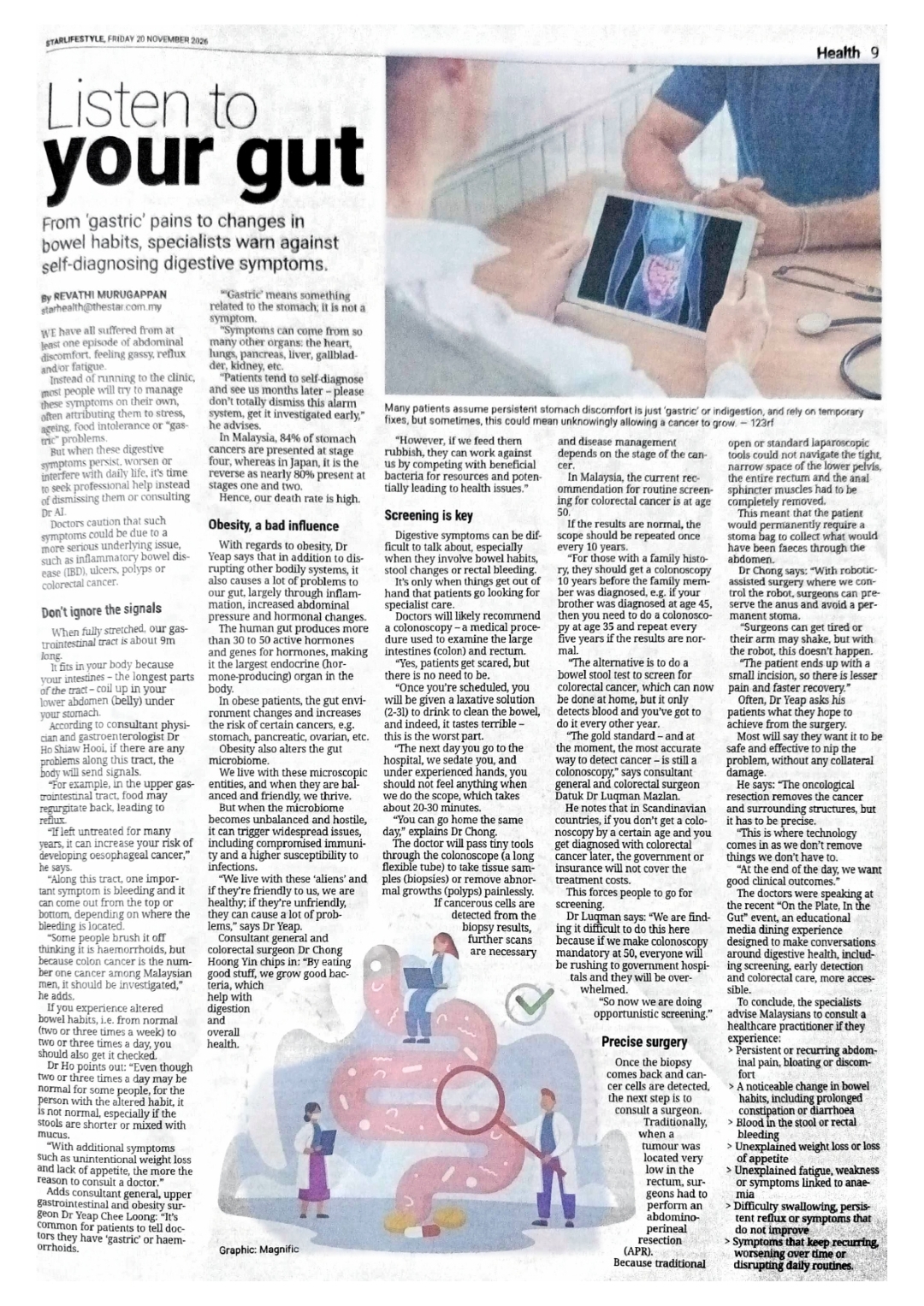
Many patients assume persistent stomach discomfort is just "gastric" or indigestion, and rely on temporary fixes, but sometimes, this could mean unknowingly allowing a cancer to grow.
WE have all suffered from at least one episode of abdominal discomfort, feeling gassy, reflux and/or fatigue.
Instead of running to the clinic, most people will try to manage these symptoms on their own, often attributing them to stress, ageing, food intolerance or "gastric" problems.
But when these digestive symptoms persist, worsen or interfere with daily life, it’s time to seek professional help instead of dismissing them or consulting Dr AI.
Doctors caution that such symptoms could be due to a more serious underlying issue, such as inflammatory bowel disease (IBD), ulcers, polyps or colorectal cancer.
Don’t ignore the signals
When fully stretched, our gastrointestinal tract is about 9m long.
It fits in your body because your intestines – the longest parts of the tract – coil up in your lower abdomen (belly) under your stomach.
According to Consultant Gastroenterologist and Physician Dr Ho Shiaw Hooi, if there are any problems along this tract, the body will send signals.
“For example, in the upper gastrointestinal tract, food may regurgitate back, leading to reflux.
“If left untreated for many years, it can increase your risk of developing oesophageal cancer,” he says.
“Along this tract, one important symptom is bleeding and it can come out from the top or bottom, depending on where the bleeding is located.
“Some people brush it off thinking it is haemorrhoids, but because colon cancer is the number one cancer among Malaysian men, it should be investigated,” he adds.
If you experience altered bowel habits, i.e. from normal (two or three times a week) to two or three times a day, you should also get it checked.
Dr Ho points out: “Even though two or three times a day may be normal for some people, for the person with the altered habit, it is not normal, especially if the stools are shorter or mixed with mucus.
“With additional symptoms such as unintentional weight loss and lack of appetite, the more the reason to consult a doctor.”
Adds Consultant General, Upper Gastrointestinal and Obesity Surgeon Dr Yeap Chee Loong: “It’s common for patients to tell doctors they have ‘gastric’ or haemorrhoids.
“‘Gastric’ means something related to the stomach; it is not a symptom.
“Symptoms can come from so many other organs: the heart, lungs, pancreas, liver, gallbladder, kidney, etc.
“Patients tend to self-diagnose and see us months later – please don’t totally dismiss this alarm system, get it investigated early,” he advises.
In Malaysia, 84% of stomach cancers are presented at stage four, whereas in Japan, it is the reverse as nearly 80% present at stages one and two.
Hence, our death rate is high.
Obesity, a bad influence
With regards to obesity, Dr Yeap says that in addition to disrupting other bodily systems, it also causes a lot of problems to our gut, largely through inflammation, increased abdominal pressure and hormonal changes.
The human gut produces more than 30 to 50 active hormones and genes for hormones, making it the largest endocrine (hormone-producing) organ in the body.
In obese patients, the gut environment changes and increases the risk of certain cancers, e.g. stomach, pancreatic, ovarian, etc.
Obesity also alters the gut microbiome.
We live with these microscopic entities, and when they are balanced and friendly, we thrive.
But when the microbiome becomes unbalanced and hostile, it can trigger widespread issues, including compromised immunity and a higher susceptibility to infections.
“We live with these ‘aliens’ and if they’re friendly to us, we are healthy; if they’re unfriendly, they can cause a lot of problems,” says Dr Yeap.
Consultant General and Colorectal Surgeon Dr Chong Hoong Yin chips in: “By eating good stuff, we grow good bacteria, which help with digestion and overall health.
“However, if we feed them rubbish, they can work against us by competing with beneficial bacteria for resources and potentially leading to health issues.”
Screening is key
Digestive symptoms can be difficult to talk about, especially when they involve bowel habits, stool changes or rectal bleeding.
It’s only when things get out of hand that patients go looking for specialist care.
Doctors will likely recommend a colonoscopy – a medical procedure used to examine the large intestines (colon) and rectum.
“Yes, patients get scared, but there is no need to be.
“Once you’re scheduled, you will be given a laxative solution (2-3l) to drink to clean the bowel, and indeed, it tastes terrible – this is the worst part.
“The next day you go to the hospital, we sedate you, and under experienced hands, you should not feel anything when we do the scope, which takes about 20-30 minutes.
“You can go home the same day,” explains Dr Chong.
The doctor will pass tiny tools through the colonoscope (a long flexible tube) to take tissue samples (biopsies) or remove abnormal growths (polyps) painlessly.
If cancerous cells are detected from the biopsy results, further scans are necessary and disease management depends on the stage of the cancer.
In Malaysia, the current recommendation for routine screening for colorectal cancer is at age 50.
If the results are normal, the scope should be repeated once every 10 years.
“For those with a family history, they should get a colonoscopy 10 years before the family member was diagnosed, e.g. if your brother was diagnosed at age 45, then you need to do a colonoscopy at age 35 and repeat every five years if the results are normal.
“The alternative is to do a bowel stool test to screen for colorectal cancer, which can now be done at home, but it only detects blood and you’ve got to do it every other year.
“The gold standard – and at the moment, the most accurate way to detect cancer – is still a colonoscopy,” says Consultant General and Colorectal Surgeon Dato' Dr Luqman Mazlan.
He notes that in Scandinavian countries, if you don’t get a colonoscopy by a certain age and you get diagnosed with colorectal cancer later, the government or insurance will not cover the treatment costs.
This forces people to go for screening.
Dr Luqman says: “We are finding it difficult to do this here because if we make colonoscopy mandatory at 50, everyone will be rushing to government hospitals and they will be overwhelmed.
“So now we are doing opportunistic screening.”
Precise surgery
Once the biopsy comes back and cancer cells are detected, the next step is to consult a surgeon.
Traditionally, when a tumour was located very low in the rectum, surgeons had to perform an abdominoperineal resection (APR).
Because traditional open or standard laparoscopic tools could not navigate the tight, narrow space of the lower pelvis, the entire rectum and the anal sphincter muscles had to be completely removed.
This meant that the patient would permanently require a stoma bag to collect what would have been faeces through the abdomen.
Dr Chong says: “With robotic-assisted surgery where we control the robot, surgeons can preserve the anus and avoid a permanent stoma.
“Surgeons can get tired or their arm may shake, but with the robot, this doesn’t happen.
“The patient ends up with a small incision, so there is lesser pain and faster recovery.”
Often, Dr Yeap asks his patients what they hope to achieve from the surgery.
Most will say they want it to be safe and effective to nip the problem, without any collateral damage.
He says: “The oncological resection removes the cancer and surrounding structures, but it has to be precise.
“This is where technology comes in as we don’t remove things we don’t have to.
“At the end of the day, we want good clinical outcomes.”
The doctors were speaking at the recent “On the Plate, In the Gut” event, an educational media dining experience designed to make conversations around digestive health, including screening, early detection and colorectal care, more accessible.
To conclude, the specialists advise Malaysians to consult a healthcare practitioner if they experience:
- Persistent or recurring abdominal pain, bloating or discomfort
- A noticeable change in bowel habits, including prolonged constipation or diarrhoea
- Blood in the stool or rectal bleeding
- Unexplained weight loss or loss of appetite
- Unexplained fatigue, weakness or symptoms linked to anaemia
- Difficulty swallowing, persistent reflux or symptoms that do not improve
- Symptoms that keep recurring, worsening over time or disrupting daily routines
Source
Listen to your gut (The Star, 20 November 2026)
Reference